Can EEG distinguish an imagined left hand from an imagined right hand? A study of public brain recordings, tested on recording runs the model never saw.
This is a replay of saved predictions on held-out EEG. It does not read your brain or train a model in your browser.
RECORDED EEG / CSP + LDA
160 Hz · C3 / Cz / C4
Loading study recordings…
Uncalibrated model scores are not certainty about mental state. The cursor resets each trial; this is discrete prediction replay, not continuous control.
Five participants are selected across the score distribution, nearest its 10th, 30th, 50th, 70th and 90th percentiles. Ties use participant ID. Every retained trial is included for these participants, including mistakes.
02 / The pipeline
Separate the signal from the claim.
01
Recordings
Public EEG from imagined hand movements. Task annotations give left and right instructions.
02
Processing
Check quality, average-reference, filter 8–30 Hz, and extract the 1–3 second window.
03
Learning
Fit spatial patterns and a classifier using two recording runs from one participant.
04
Evaluation
Predict the third run. Rotate all three runs and compare against two fixed baselines.
03 / Evidence
Performance, with context.
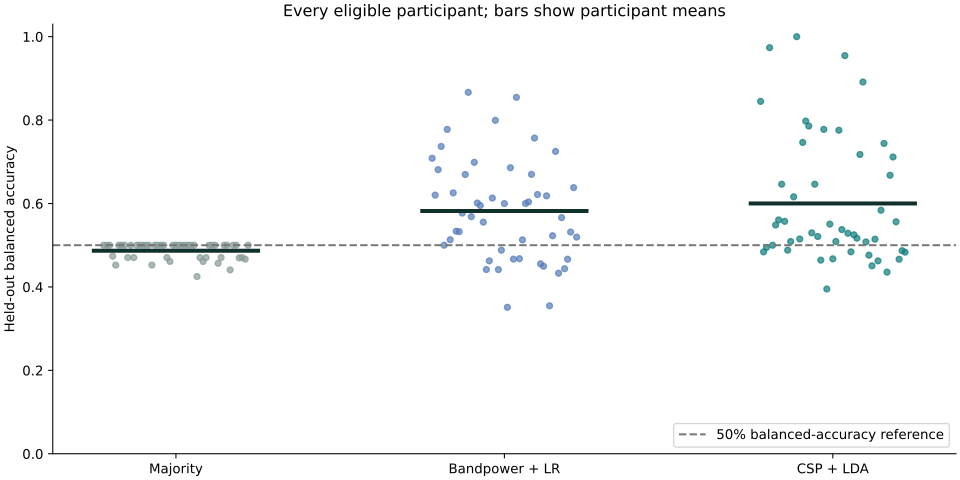
The primary metric is mean participant balanced accuracy. Each participant has equal weight; the intervals resample participants.
PhysioNet EEGMMIDB v1.0.0, runs 4, 8 and 12: T1 is imagined left hand; T2 is imagined right hand; rest is excluded. Recordings have 64 EEG channels sampled at 160 Hz.
Validate checksums, electrode names, sampling rate and annotation timing. Exclude missing, nonfinite or flat-channel recordings. Reject incomplete task windows and epochs exceeding 500 µV peak-to-peak before filtering. Require all three runs and at least five retained trials per class in each run.
Process each run separately with average referencing and an offline, zero-phase 8–30 Hz FIR filter. Use the 1–3 s post-cue window. Fit every learned step on the training runs only.
Compare a majority baseline, Welch log-bandpower with standardized logistic regression (C=1), and four-component CSP with Ledoit–Wolf covariance shrinkage followed by shrinkage LDA. No hyperparameter tuning. Bootstrap participants 2,000 times with seed 42.
Meaningful boundaries
Labels describe what a participant was instructed to imagine, not direct access to their thoughts. Visual cues and eye or muscle artifacts may contribute to classification.
This measures between-run performance for the same participant. It does not establish results for unseen people, later sessions, clinical populations, or live feedback.
Zero-phase filtering uses future samples. Replay timing is therefore not evidence of real-time decoding latency. The fixed amplitude cutoff is a project choice, not a clinical standard.
All measured results are reported, including errors. Model scores are uncalibrated. This is an offline research project, not a medical device.